
Home / Forestry Mulching & Land Clearing FAQ: East Texas
Forestry Mulching & Land Clearing FAQ: East Texas
Answers to the questions East Texas landowners ask us most about forestry mulching, land clearing and brush removal. Texas Homestead Company is based in Hawkins, TX and serves Hawkins, Longview, Tyler, Mineola and communities within about 100 miles. Call (903) 521-5222 for a free estimate.
Forestry Mulching
What is forestry mulching?
Forestry mulching clears brush, small trees and undergrowth with one machine. A spinning drum with heavy teeth grinds the vegetation where it stands and leaves it on the ground as a layer of mulch, so there is nothing to pile, burn or haul away.
At Texas Homestead we use forestry mulching for brush clearing and mowing, tree and vegetation mulching, stump and root grinding, and firebreak, trail and driveway clearing across East Texas.
How is forestry mulching different from bulldozing or traditional land clearing?
Traditional clearing usually pushes trees and brush into piles that then have to be burned or hauled off, and it often leaves bare dirt. Forestry mulching grinds the material in place, eliminating burn piles and leaving a mulch layer that helps reduce erosion.
The Texas A&M Forest Service notes that mulching carries much less liability than burning, can be done throughout the year (no burn-ban delays), helps the soil hold moisture, and reduces erosion. If you need stump-free, build-ready dirt for a slab or pad, mulching is usually combined with grading or pad work, which we also offer.
How much does forestry mulching cost per acre?
It depends on the land. What sets the price is how thick the brush is, how big the trees are, and how steep or wet the ground is. A few acres of light brush and a few acres of dense cedar and hardwood thicket are very different jobs. That’s why we give free estimates. We’ll look at your property, in person or from photos and an aerial map, and give you a clear price before any work starts. For a rough idea, national cost guides generally put forestry mulching somewhere around $1,500 to $4,000 per acre depending on density. That’s an industry reference, not our quote. Call (903) 521-5222 and we’ll give you a real number for your land.
How many acres can you mulch in a day, and what equipment do you use?
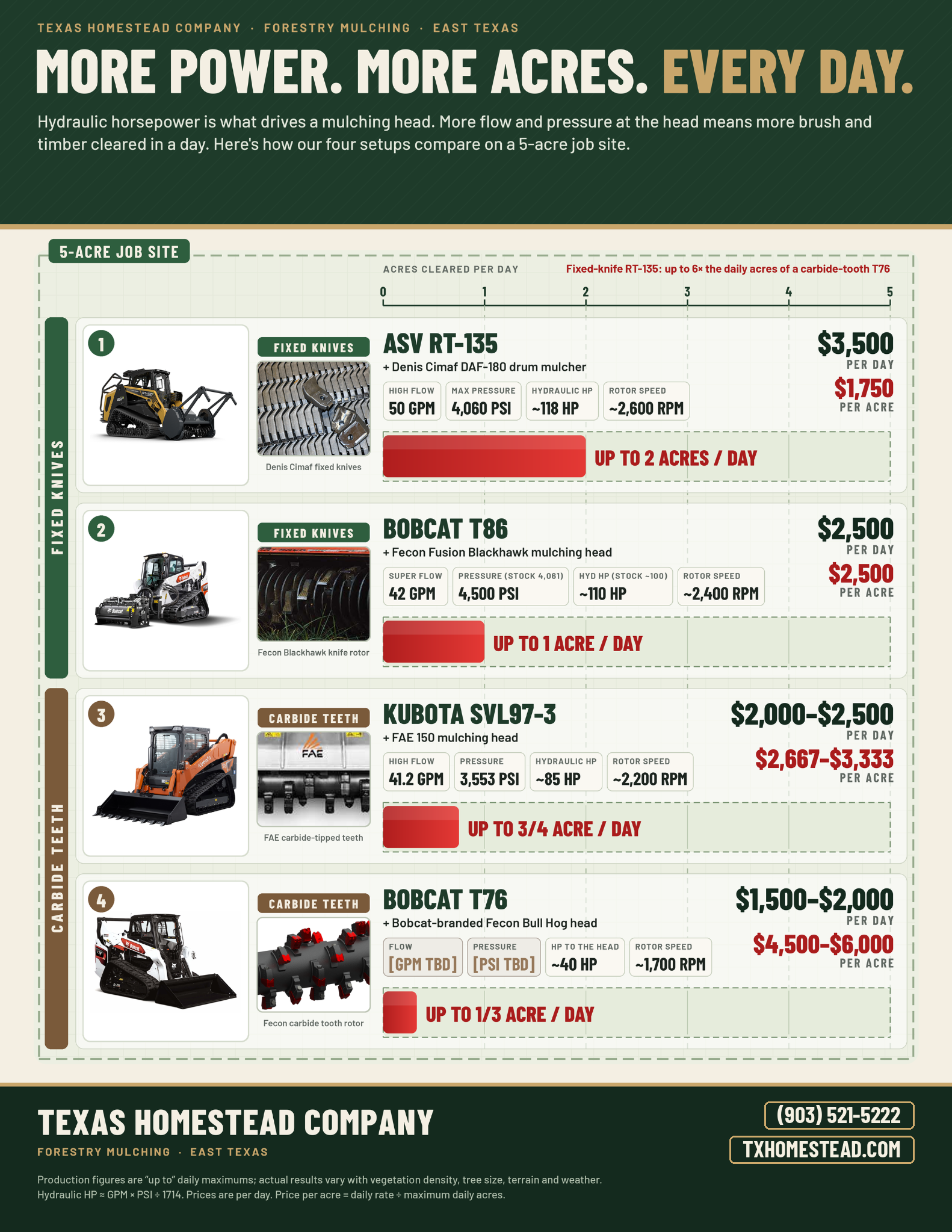
It comes down to how thick the growth is. Light brush and small saplings go fast. Dense thickets with bigger trees take a lot longer per acre. We’ll give you a realistic timeline for your property along with your estimate. Our highest-production machine is an ASV RT-135 with a Denis Cimaf DAF-180 drum mulcher, and we also run a Bobcat T86 with a Fecon Fusion Blackhawk mulching head. Both are built for East Texas brush and timber, so we can grind most volunteer trees and underbrush right where they stand without hauling anything off. Both heads use fixed knives instead of carbide teeth. Knives slice through wood like small axes and leave a clean, fine mulch, while carbide teeth hammer at it and tend to leave long, stringy shreds. Trees bigger than the mulcher handles can be cut and dealt with separately. We’ll go over that during the walk-through.
Will the brush grow back after forestry mulching?
Some of it can. Mulching removes what is standing, but roots stay alive, and East Texas species such as yaupon resprout from live root material. Texas A&M AgriLife describes mechanical control of yaupon as fast but temporary, and the Texas A&M Forest Service says mechanical treatment is never a single solution to brush control and is usually followed by an herbicide treatment or routine maintenance.
The mulch layer slows regrowth while it breaks down. If you want land to stay open, plan on a follow-up treatment or a light maintenance pass in the first few years; we can talk through options during your estimate.
What happens to the mulch, and how long does it take to break down?
The mulch stays on your property as the finished surface. The Texas A&M Forest Service recommends a final mulching height of about two to four inches, and the layer helps hold soil in place, keeps moisture in and returns organic matter to the soil.
In East Texas heat and rain, mulch typically starts breaking down within a few months and largely decomposes within about one to two years, depending on how thick it is and how wet the year is. Native grasses usually come back through a moderate layer.
Does forestry mulching remove stumps?
A forestry mulcher grinds stumps down at or slightly below ground level; it does not pull them out. At Texas Homestead, tree stump removal, stump grinding and tree root removal are part of our mulching package so the land is cleared and ready for building or restoration.
If you are preparing a house pad, slab or driveway that needs stump-free, compacted dirt, we can add land grading and pad work to the same project.
Can you mulch around trees I want to keep?
Yes. Selective clearing is one of the main reasons people choose forestry mulching over a bulldozer. Before we start, we’ll walk the property with you, and you can point out or flag the trees you want saved, like good oaks, shade trees or anything near the house site. We clear the underbrush, cedar and volunteer growth around them and leave the keepers standing, with the ground and root zones left mostly undisturbed. A lot of folks want their land opened up so it feels like a park but still has its best trees. That’s exactly what this kind of work is good for.
When is the best time of year for forestry mulching? Can you work when it is wet?
Forestry mulching can be done year-round, which is one of its advantages over burning. The Texas A&M Forest Service notes that green, living vegetation mulches best, and that very wet sites, steep slopes and ground with large rocks or debris may not be suitable for machine mulching.
We can keep mulching through light to moderate rain, so a drizzly day usually doesn’t stop work. Heavy rain or saturated ground may still delay work so we don’t rut your property. We’ll stay in touch with you before work begins and let you know right away if the schedule needs to change.
Land Clearing
What land clearing services do you offer?
Texas Homestead offers forestry mulching, land clearing (tree clearing, brush and vegetation removal, lot and site clearing, and land cleanup), homesite preparation, driveway and access clearing, brush cutting and property maintenance, excavation and dirt work, land grading, and pads and roads.
We work on residential, ranch and small commercial projects.
Can you prepare a homesite, house pad or driveway?
Yes. Homesite preparation and driveway and access clearing are part of what we do. As secondary site prep after clearing, we also build site pads, driveways and private roads and do land grading for drainage and stability. Many projects combine forestry mulching or land clearing with grading and pad or driveway work so the land is ready for your builder.
Do I need a permit to clear land in East Texas?
It depends on where the property is. Under our terms, clients are responsible for obtaining any necessary permits unless other arrangements are made. Things to check before clearing include:
- City rules if the property is inside city limits.
- Wetlands, creeks or other waters: mechanized land clearing in jurisdictional wetlands can require a U.S. Army Corps of Engineers permit under Clean Water Act Section 404.
- Any digging, grading or excavation: Texas law requires a call to Texas811 at least two business days before you dig so underground utilities can be marked.
Do you burn brush piles?
Usually not. Forestry mulching does away with most brush piles. The mulcher grinds trees and brush into a layer of mulch that stays on the ground, so there’s nothing left to push up, burn or haul off. That’s good for the soil, it means no smoke or burn-pile scars, and you don’t have to worry about county burn bans, which come up often in East Texas during dry spells. That said, every job is different, and if yours calls for burning, we can handle that too. If you already have old brush piles on the property, ask us about them during your estimate.
Who calls 811 and handles underground utilities?
Texas law requires a call to 811 (Texas811) before anyone digs, so buried lines like gas, electric, water and fiber can be marked. Most forestry mulching works at or above ground level, but Site Prep work and some clearing jobs do break ground. When a job involves digging, we’ll talk through the 811 ticket with you during the estimate and planning stage, including who will place the call and when, so everything is marked before work starts. We’ll also ask you about anything private that 811 won’t mark, like water lines to a barn, septic systems, buried power to a well pump or old pipelines, so we can steer clear of them.
Can you help me find my property lines or pick a spot for my house?
We’re glad to walk the land with you and help you think through where a house, barn, driveway or pasture would fit best. Clearing out the brush first often makes it a lot easier to see the lay of the land. We aren’t surveyors, though, and we can’t legally establish property lines. If you’re clearing near a boundary, we’ll work from your survey pins, fence lines or a recent survey. If the line is in question, we recommend having a licensed surveyor stake it before we clear along it. That protects you and your neighbor.
Brush Removal
What is the difference between brush mowing and forestry mulching?
Brush mowing (shredding) uses a rotary cutter, like a brush hog, to cut grass and light brush down to a few inches. A forestry mulcher grinds heavier material (thick undergrowth, saplings, small trees and stumps) and leaves it as mulch.
We offer both: brush clearing and mowing is ideal for maintaining pastures, fence lines and trails, while forestry mulching handles dense undergrowth, thickets and small trees.
Can you clear thick yaupon and other East Texas underbrush?
Yes. Our brush clearing removes dense undergrowth, thickets, vines, shrubs and overgrown weeds, and our tree and vegetation mulching handles small trees.
Yaupon is a perennial that can resprout from live roots, so Texas A&M AgriLife recommends planning for re-treatment or a follow-up herbicide program if you want it gone long term.
Do you clear fence lines, trails and firebreaks?
Yes. We clear fire lanes, paths and driveways using heavy-duty forestry mulchers, and our brush clearing and mowing service is ideal for maintaining pastures, fence lines and trails.
The Texas A&M Forest Service notes that mulching reduces ladder fuels, such as tall brush that can carry a ground fire up into trees, which lowers wildfire intensity.
Do you clean up storm damage and fallen trees?
Yes. After a storm, we can clear downed trees, broken limbs and tangled brush from pastures, fence lines, trails and wooded acreage, and grind most of it into mulch right there. That’s usually faster and cleaner than cutting it up and hauling it off. We don’t remove trees that have fallen on houses, buildings or power lines. Call your insurance company, a tree service or the utility company for those first. Once those are taken care of, we can help clean up the rest of the property.
Service Area & Booking
What areas do you serve?
Texas Homestead is based in Hawkins, Texas (1279 Co Rd 3420, Hawkins, TX 75765) and serves East Texas within about 100 miles of Hawkins, including Hawkins, Longview, Tyler, Mineola, Gilmer, Marshall, Lindale, Gladewater, Winnsboro, Sulphur Springs, Grand Saline, Canton, Athens and Jacksonville. If your property is in the area but not listed, call (903) 521-5222.
Do you offer free estimates?
Yes. We provide free, no-obligation estimates after an initial consultation. Estimates are non-binding; final pricing is determined after an on-site assessment. Call (903) 521-5222.
How does the booking process work?
- Initial consultation: a quick, no-obligation conversation about your land and goals.
- Custom quote: a detailed, upfront quote with no hidden fees.
- Job scheduled and completed: once you approve, we schedule and complete the work.
- Final invoice: after the work is done, we send your invoice.
How do I pay, and what is your cancellation policy?
Full payment is due when the job is completed unless otherwise agreed in writing. We accept cash, credit card and online payment. You can cancel or reschedule up to 24 hours before your scheduled service; late cancellations may be subject to a fee.
How soon can you start my project?
It depends on the time of year and how busy the schedule is, and weather plays a big part in East Texas. After heavy rain, we may need to wait for the ground to firm up so we don’t rut your property. When you call for your free estimate, we’ll give you an honest idea of when we can get to you, and we’ll keep you posted if weather moves things around. Call (903) 521-5222 to get on the schedule.
Still have a question?
Call (903) 521-5222 or request a free estimate.